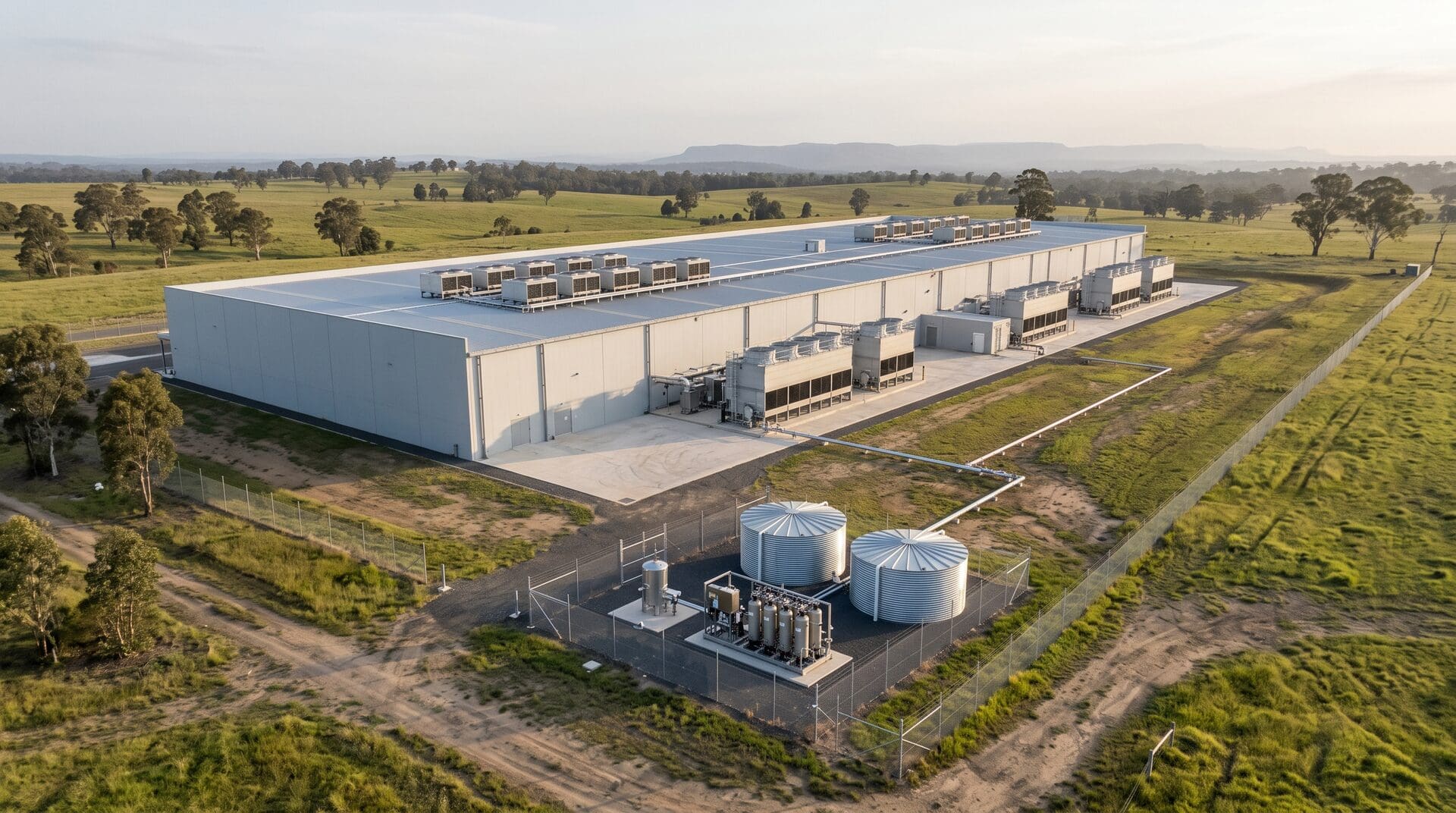
How much water does a data centre use? More than most planning submissions admit. A facility that cools by evaporation draws water continuously, and the larger the facility, the larger the draw. In New South Wales the answer now shapes how new data centres are planned and approved, not just how they are engineered.
This guide sets out the Australian figures, explains why cooling is where the water goes, covers the 2026 national and NSW expectations on water use, and looks at the non-potable sources a data centre can use instead of drinking water.
How much water does a data centre use in Australia?
Australian water utilities have reported applications from data centre proponents seeking between 5 and 40 million litres a day. The range is wide because facilities differ in size, but even the bottom of it is a large, continuous industrial demand on a city network.
Across the country, industry analysis puts direct on-site water use by Australia's data centres, mostly for cooling, at around 5.5 gigalitres a year. In Sydney, the city's water utility told the NSW parliamentary inquiry into data centres that cumulative demand in a high-growth scenario could reach 250 million litres a day by 2035.
Those numbers are why water now sits alongside power in data centre planning, and why our page on data centre water supply sizes a supply against the cooling design rather than an annual average.
Why cooling is where the water goes
Most of a data centre's water goes to cooling. Data centres that use evaporative cooling consume water continuously, and the water the cooling system loses has to be replaced. That cooling make-up water is the largest continuous draw on an evaporatively cooled site.
Make-up water does not need to be drinking quality. It needs to be the quality the cooling system needs. That shifts the question for a new facility from how much water it uses to which water it uses, and keeps the potable connection available for the uses that genuinely need it.
Water usage effectiveness and the 2026 rules
Water usage effectiveness, or WUE, expresses a data centre's water use in litres a kilowatt-hour. The lower the figure, the less water the facility uses for each unit of energy. Two sets of 2026 rules now put that figure, and the source of the water, in front of every new proposal.
The national expectations, March 2026
On 23 March 2026 the Australian Government's Expectations of Data Centres and AI Infrastructure Developers put sustainable water use into the national data centre investment framework. Developers are expected to look at efficient cooling technologies, non-potable water where possible, circular water opportunities, resilience against drought, and transparent reporting on water use and efficiency.
The NSW Data Centre Guidelines, August 2026
NSW followed in August 2026 with paired thresholds: a design power usage effectiveness of 1.25 or better, and a water usage effectiveness no worse than 1.0 litres a kilowatt-hour on potable water, or 1.6 on non-potable water. The guidelines also directed proponents to recycled water for water-intensive cooling, or to an agreement with their utility to move to a rainfall-independent supply.
The higher allowance for non-potable water is the practical signal. A facility cooled on non-potable water has more room under the threshold than one cooled on drinking water.
How a data centre can reduce its potable water use
The options in the guidelines come down to sources that are not drinking water and do not depend on rainfall. Recycled water is one. Treated groundwater is another: a non-potable, rainfall-independent source that can be licensed, built and delivered on the proponent's own site or from a nearby licensed source.
The two are not either-or. Groundwater can sit beside a recycled water connection as a second, independent non-potable source, and aquifers do not follow restriction cycles, which is the resilience the national expectations ask developers to demonstrate.
A groundwater source has to be proven before it is relied on. A groundwater investigation with test drilling and yield testing establishes what the aquifer will sustain, so the volume committed to the facility is one the aquifer has demonstrated.
The water then has to meet the cooling specification. Bore water treatment systems are designed to the end use, with the target quality for cooling make-up set before the plant is sized to the flow.
Water licensing runs in parallel with the facility's own planning approvals, so a groundwater option is real at the point the cooling design is fixed. Metered and reported extraction then gives the facility the transparent water-use record the national framework expects.
If you are planning or expanding a data centre in the Sydney Basin and want to understand a non-potable groundwater option, call us on 0408 915 449 or send your site details through our contact page.